
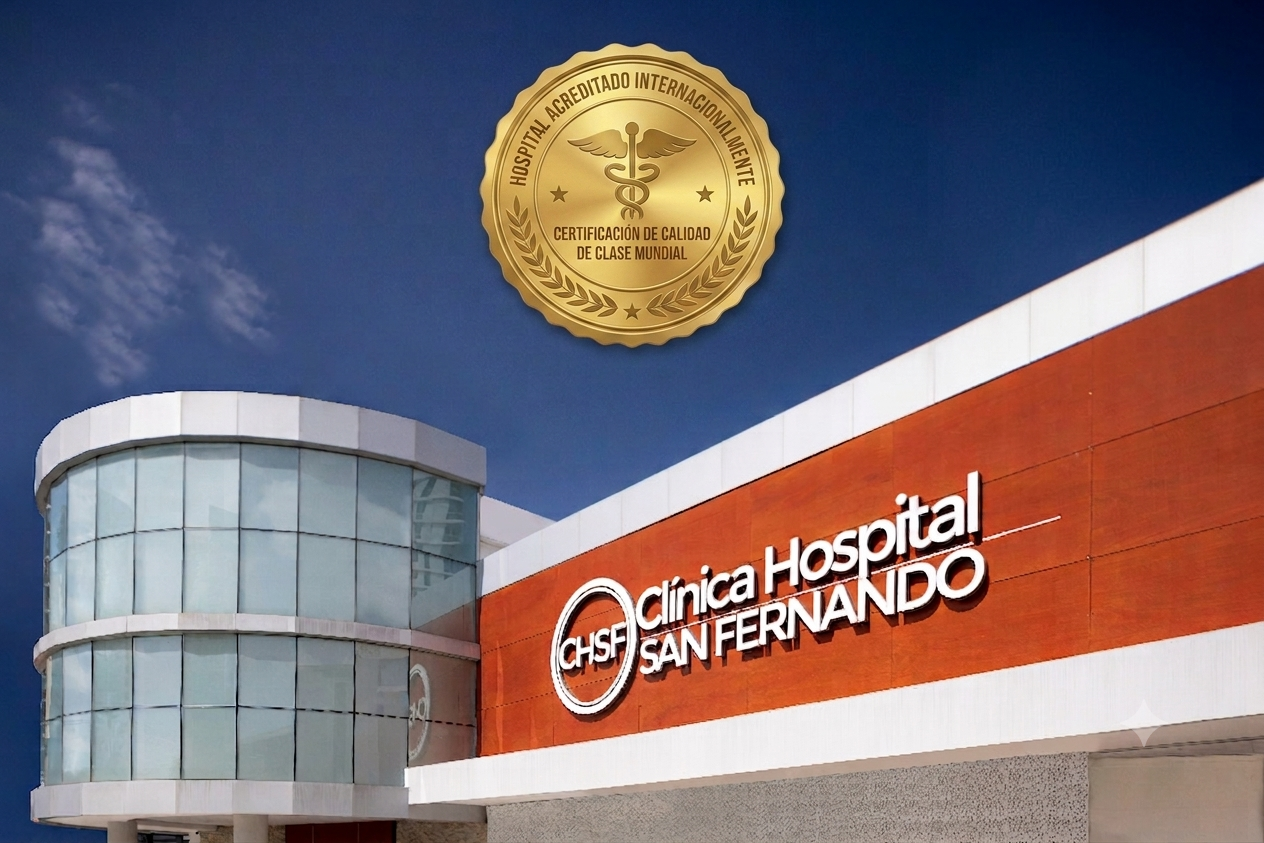
When a person needs medical attention, surgery, a specialized test, or even a routine checkup, they place something invaluable in the hands of a healthcare institution: their trust. Behind that trust lies a set of processes, protocols, standards, and safety measures that often go unnoticed by patients but are fundamental to guaranteeing safe, high-quality medical care.
One of the highest recognitions a healthcare institution can receive is international accreditation. Although many people have heard this term, few truly understand what it means, how to obtain it, and, above all, why it directly benefits patients and their families.
At Clínica Hospital San Fernando, we understand that medical excellence goes beyond having highly trained specialists or advanced technology. It also means adhering to international standards that aim to guarantee patient safety at every stage of their care.
What is an international health accreditation?
An international accreditation is a recognition granted by specialized bodies that assess whether a hospital meets rigorous standards of quality, safety, clinical management and patient care.
To obtain this type of accreditation, institutions undergo exhaustive evaluation processes that review aspects such as:
- Patient safety.
- Quality of care.
- Clinical protocols.
- Risk management.
- Infection control.
- Staff training.
- Maintenance of medical equipment.
- Surgical procedures.
- Urgent Care.
- Medication management.
This is not a one-time certification. Institutions must continuously demonstrate that they maintain and improve their quality standards.
Why is this important for patients?
When a hospital works under international standards, patients receive benefits that directly impact their experience and safety.
Greater safety during care
Patient safety is one of the fundamental pillars of international accreditations. This means that there are procedures in place designed to minimize risks, prevent errors, and ensure that every patient receives the appropriate care at the right time.
For example:
- Identity verification before procedures.
- Surgical safety protocols.
- Strict medication control.
- Infection prevention processes.
- Monitoring and continuous improvement systems.
These measures help reduce risks and strengthen patient confidence.
Quality at every stage of care
Quality is not limited to the moment of the medical consultation. It also includes:
- The admissions process.
- Emergency care.
- Diagnostic tests.
- Surgical interventions.
- Hospitalization.
- The follow-up.
An accredited institution seeks to offer a consistent and safe experience at every point of contact with the patient.
Technology backed by secure processes
Having modern equipment is important, but just as important as the technology is knowing how to use it under appropriate protocols.
At Clínica Hospital San Fernando, services such as:
- Clinical laboratory.
- Radiology and diagnostic imaging.
- Tomography.
- Ultrasound.
- Magnetic resonance imaging.
- Endoscopic center.
- Specialized operating rooms.
They are part of a care ecosystem that seeks to ensure accurate diagnoses and safe procedures.
The importance of continuous improvement
Medicine is constantly evolving. New technologies, treatments, and protocols appear every year. For this reason, an institution committed to quality must maintain ongoing programs of:
- Medical training.
- Training of nursing staff.
- Technological update.
- Process review.
- Evaluation of clinical indicators.
Continuous improvement allows patients to receive care aligned with the best available practices.
Safety in critical areas of the hospital
Emergency room: Medical emergencies require speed, coordination, and precision. International standards promote protocols that enable:
• Appropriate triage.
• Prioritized care according to severity.
• Effective communication between medical teams.
• Rapid response to critical situations.
Operating rooms: Surgical safety is one of the most thoroughly evaluated aspects in accreditation processes. This includes:
• Patient identity verification.
• Confirmation of the procedure.
• Sterility control.
• Post-operative follow-up.
• Recovery protocols.
Hospitalization: The standards also cover:
• Fall prevention.
• Infection control.
• Safe administration of medications.
• Continuous patient monitoring.
A commitment that benefits the whole family
International accreditation not only benefits patients receiving medical care. It also provides peace of mind to family members and caregivers, who know that the institution operates under internationally recognized standards to protect the health and well-being of its patients.
People. The value of choosing a hospital committed to excellence.
When it comes to health, quality should not be an option, but a priority.
Choosing an institution committed to international standards means trusting in processes designed to protect the patient, optimize clinical outcomes, and offer a safer and more humane care experience.
At Clínica Hospital San Fernando, we work daily to strengthen a culture of quality, safety and continuous improvement, supported by highly trained professionals, advanced medical technology and a vision focused on the well-being of our patients.
Because when it comes to health, every detail counts and every process has a purpose: to provide safe, reliable, and excellent care.
